cute pictures of animals, Animals are multicellular, eukaryotic organisms of the kingdom Animalia (also called Metazoa). Their body plan eventually becomes fixed as they develop, although some undergo a process of metamorphosis later on in their lives. Most animals are motile, meaning they can move spontaneously and independently. All animals must ingest other organisms or their products for sustenance .
Home » All posts
african lion
The Southwest African lion or Katanga lion is a subspecies of the lion that lives in southwestern Africa, where it is found in Namibia, Angola, Zaire, western Zambia, western Zimbabwe and northern Botswana. The type specimen was from Katanga
asiatic lion
The Asiatic lion, also known as the Indian lion, is a lion subspecies that exists as a single isolated population in India's Gujarat State. It is listed as Endangered by IUCN based on the small population size.
lion photos
lion photos ,.Traditionally, 12 recent subspecies of lion were recognised, distinguished by mane appearance, size, and distribution. Because these characteristics are very insignificant and show a high individual variability, most of these forms were probably not true subspecies, especially as they were often based upon zoo material of unknown origin that may have had "striking, but abnormal" morphological characteristics.
Today, only eight subspecies are usually accepted,although one of these, the Cape lion, formerly described as Panthera leo melanochaita, is probably invalid. Even the remaining seven subspecies might be too many.
While the status of the Asiatic lion (P. l. persica) as a subspecies is generally accepted, the systematic relationships among African lions are still not completely resolved. Mitochondrial variation in living African lions seemed to be modest according to some newer studies, therefore all sub-Saharan lions sometimes have been considered a single subspecies, however, a recent study revealed lions from western and central Africa differ genetically from lions of southern or eastern Africa
pictures of animals
pictures of animals , Animals are generally considered to have evolved from a flagellated eukaryote.Their closest known living relatives are the choanoflagellates, collared flagellates that have a morphology similar to the choanocytes of certain sponges.
Molecular studies place animals in a supergroup called the opisthokonts, which also include the choanoflagellates, fungi and a few small parasitic protists.The name comes from the posterior location of the flagellum in motile cells, such as most animal spermatozoa, whereas other eukaryotes tend to have anterior flagella.
lion facts
lion facts, Another study revealed there are three major types of lions, one North African–Asian, one southern African and one middle African.Conversely, Per Christiansen found that using skull morphology allowed him to identify the subspecies krugeri, nubica, persica, and senegalensis, while there was overlap between bleyenberghi with senegalensis and krugeri.
The Asiatic lion persica was the most distinctive, and the Cape lion had characteristics allying it more with P. l. persica than the other sub-Saharan lions. He had analysed 58 lion skulls in three European museums.
The majority of lions kept in zoos are hybrids of different subspecies.
Approximately 77% of the captive lions registered by the International Species Information System are of unknown origin. Nonetheless, they might carry genes which are extinct in the wild, and might be therefore important to maintain overall genetic variability of the lion.
It is believed that those lions, imported to Europe before the middle of the nineteenth century, were mainly either Barbary lions from North Africa or lions from the Cape.
pictures of lions
pictures of lions, The lion's closest relatives are the other species of the genus Panthera: the tiger, the jaguar, and the leopard. P. leo evolved in Africa between 1 million and 800,000 years ago, before spreading throughout the Holarctic region.
It appeared in the fossil record in Europe for the first time 700,000 years ago with the subspecies Panthera leo fossilis at Isernia in Italy. From this lion derived the later cave lion (Panthera leo spelaea), which appeared about 300,000 years ago.
Lions died out in northern Eurasia at the end of the last glaciation, about 10,000 years ago, this may have been secondary to the extinction of Pleistocene megafauna
Steller's Sea Eagle
The Steller's Sea Eagle (Haliaeetus pelagicus) is a large bird of prey in the family Accipitridae. It is an eagle that lives in coastal northeastern Asia and mainly preys on fish and water birds.
On average, it is the heaviest eagle in the world, at about 5 to 9 kilograms (11 to 20 lb), but may lag behind the Harpy Eagle (Harpia harpyja) and Philippine Eagle (Pithecophaga jefferyi) in some standard measurements. This bird is named after the German naturalist Georg Wilhelm Steller.
White tailed Tropic bird
The White tailed Tropic bird Phaethon lepturus, is a tropicbird, smallest of three closely related seabirds of the tropical oceans and smallest member of the order Phaethontiformes. It occurs in the tropical Atlantic, western Pacific and Indian Oceans.
It also breeds on some Caribbean islands, and a few pairs have started nesting recently on Little Tobago, joining the Red-billed Tropicbird colony. In addition to the tropical Atlantic, it nests as far north as Bermuda, where it is locally called a "Longtail".
Shoebill
The Shoebill (Balaeniceps rex) also known as Whalehead or Shoe-billed Stork, is a very large stork-like bird. It derives its name from its massive shoe-shaped bill. Although it has a somewhat stork-like overall form and has previously been classified in the order Ciconiiformes, its true affiliations with other living birds is ambiguous.
Some authorities now reclassify it with the Pelecaniformes. The adult is mainly grey while the juveniles are browner. It lives in tropical east Africa in large swamps from Sudan to Zambia.
Red crested Turaco
The Red crested Turaco (Tauraco erythrolophus) is a turaco, a group of African near-passerines. It is a frugivorous bird endemic to western Angola. Its call sounds somewhat like a jungle monkey.
The National Bird of Angola is the striking, endemic Red-crested Turaco. The turaco itself is becoming a national icon for conservation, especially bird and forest conservation. It occurs quite commonly along the length of the Angolan escarpment and adjacent forested habitats.
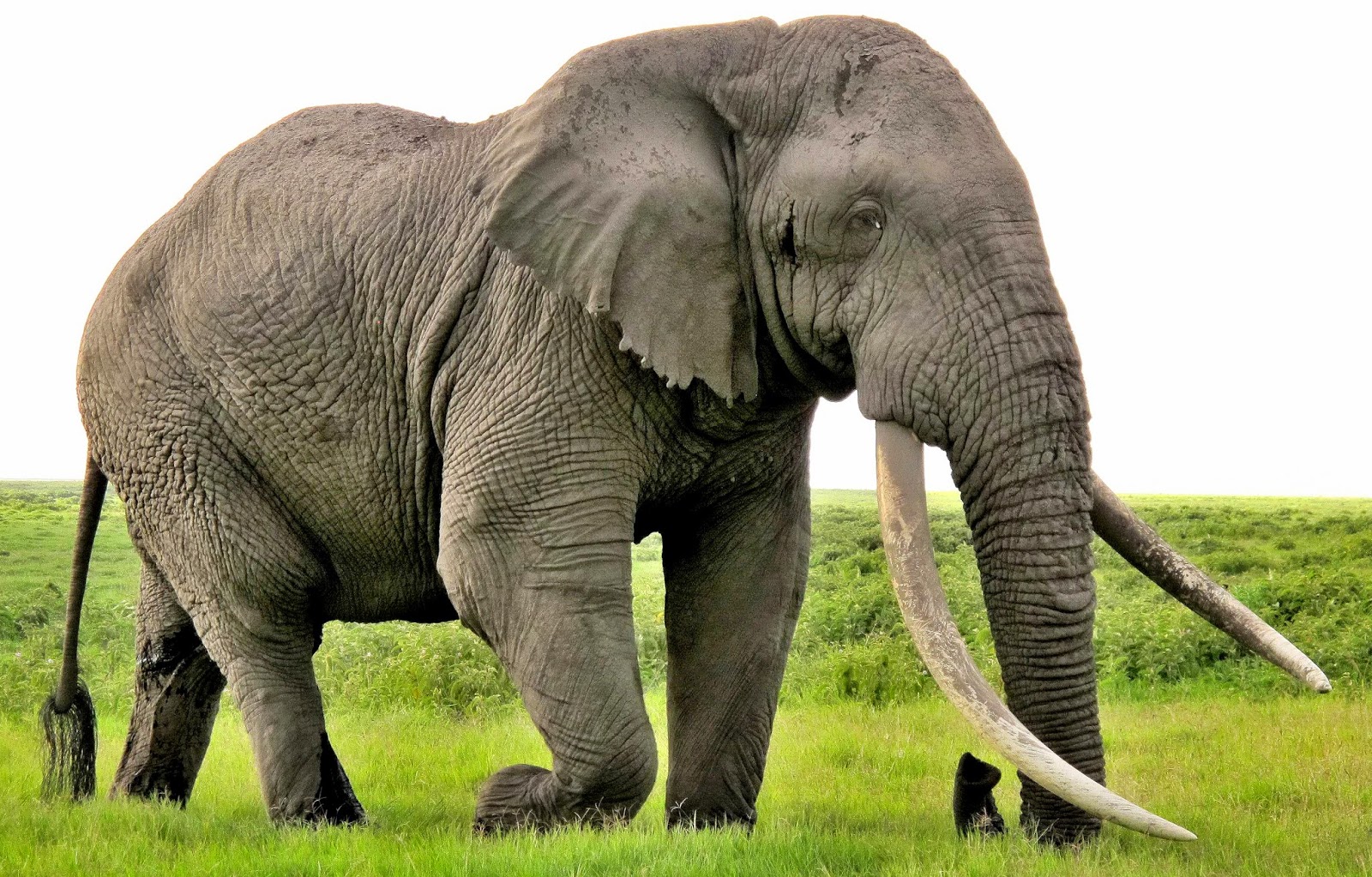
Elephant
All elephants have several distinctive features the most notable of which is a long trunk or proboscis, used for many purposes, particularly breathing, lifting water and grasping objects. Their incisors grow into tusks, which can serve as weapons and as tools for moving objects and digging.
Elephants' large ear flaps help to control their body temperature. African elephants have larger ears and concave backs while Asian elephants have smaller ears and convex or level backs.
elephant facts
elephant facts are large mammals of the family Elephantidae and the order Proboscidea. Traditionally, two species are recognised, the African elephant (Loxodonta africana) and the Asian elephant (Elephas maximus), although some evidence suggests that African bush elephants and African forest elephants are separate species (L. africana and L. cyclotis respectively).
Elephants are scattered throughout sub-Saharan Africa, South Asia, and Southeast Asia. Elephantidae are the only surviving family of the order Proboscidea; other, now extinct, families of the order include mammoths and mastodons. Male African elephants are the largest surviving terrestrial animals and can reach a height of 4 m (13 ft) and weigh 7,000 kg (15,000 lb).
endangered animals
An endangered animals is a species of organisms that will likely become extinct. The phrase 'endangered species' colloquially refers to any species that fits this description whereas conservation biologists typically use it to refer to species that are designated Endangered in the IUCN Red List, wherein "endangered" is the second most severe conservation status for wild populations, following Critically Endangered. 3079 animals and 2655 plants are Endangered worldwide, compared with 1998 levels of 1102 and 1197, respectively.
The amount, population trend, and conservation status of each species can be found in the Lists of organisms by population.
Lion
Lions live for 10–14 years in the wild, while in captivity they can live longer than 20 years. In the wild, males seldom live longer than 10 years, as injuries sustained from continual fighting with rival males greatly reduce their longevity.
They typically inhabit savanna and grassland, although they may take to bush and forest. Lions are unusually social compared to other cats. A pride of lions consists of related females and offspring and a small number of adult males.
Groups of female lions typically hunt together, preying mostly on large ungulates. Lions are apex and keystone predators, although they scavenge as opportunity allows.
While lions do not typically hunt humans, some have been known to do so. Sleeping mainly during the day, lions are primarily nocturnal, although bordering on crepuscular in nature.
african animals
african animals, africa is a country of its natural state is very hard, all the universe africa very unique and rich variety of fauna, fauna africa is also the contributors, for the enrichment equipment keragamannya world collection of animals
white lion animal
white lion animal are not albinos. Their white colour is caused by a recessive trait derived from a less-severe mutation in the same gene that causes albinism, distinct from the gene responsible for white tigers. They vary from blonde to near-white.
This coloration does not appear to disadvantage their survival. The white lions of the Global White Lion Protection Trust (GWLPT) have been reintroduced into their natural habitat and have been hunting and breeding successfully without human intervention for a significant amount of time.